Artificial Intelligence
Five Years of Apple Silicon: Performance Comparison of M1 and M5
2 min read
08.12.2025
Celebrating the fifth anniversary of Apple silicon with a performance comparison of the M1 and M5 chips.
Fifth Anniversary of Apple Silicon Chip
Today marks the fifth anniversary of the Apple Silicon chip, which replaced Intel processors in the Mac lineup. The first chip, M1, was introduced on November 10, 2020. It first appeared in the MacBook Air, Mac mini, and 13-inch MacBook Pro, offering the "world's fastest CPU" and outstanding performance per watt.
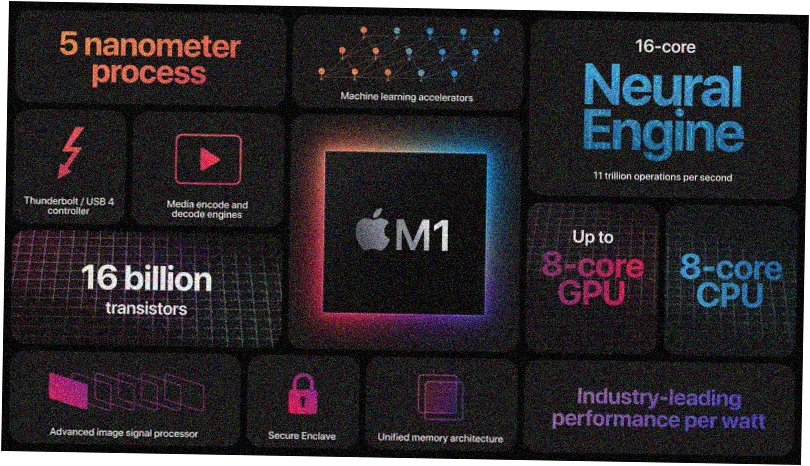
During this time, five generations of Apple Silicon have emerged, with the latest being the M5, presented last month for the 14-inch MacBook Pro. A comparison of M5 to M1 shows significant growth: the CPU and GPU are six times faster, AI performance has increased sixfold, AI video processing is up by 7.7 times, 3D rendering has improved by 6.8 times, gaming performance is 2.6 times better, and compilation speed has increased by 2.1 times.
Geekbench testing also confirms this growth: the single-core M1 scored 2320 points, while M5 scored 4263; the multi-core M1 scored 8175, and M5 scored 17862. Metal scores for graphics also rose from 33041 to 75637.
Both processors have significantly enhanced AI and gaming performance, particularly due to hardware ray tracing and the Neural Engine. The M1 is built on TSMC's 5nm technology (N5), while the M5 is based on the third generation of 3nm (N3P). The M1 is derived from the A14 Bionic chip of the iPhone 12, while the M5 is based on the A19 Pro from iPhone 17 Pro.
In terms of specifications, the M1 has 8 CPU cores and 8 GPU cores, while the M5 has 10 cores each. Clock speeds have increased from 3.2 GHz to 4.61 GHz, respectively. The M5 also features integrated neural accelerators in each GPU core and a third-generation ray tracing engine. The M1 supports up to 16 GB of memory with a bandwidth of 68.25 GB/s, while the M5 supports up to 32 GB with 153 GB/s.
For three years, Apple offered Macs with Intel processors alongside models featuring Apple Silicon. The last of these was discontinued in June 2023. Since then, all Apple devices are equipped solely with proprietary chips, and software support for Intel Macs is already diminishing, ceasing with macOS Tahoe.
Looking to the future, TSMC is already working on 2nm processors that may appear as early as 2026, promising a speed increase of 10-15% and a reduction in power consumption by 25-30%. By 2028, 1.4nm chips are expected for even greater performance and efficiency.
 TGLIST.COM.UA
Comments
No comments
Add Comment