The magnetic field at its center plays a key role in shaping the structure.
The space telescope "James Webb" captured an impressive image of the Lynds 483 nebula (LBN 483), located 650 light-years away from us. The structure resembles an hourglass or a butterfly and formed due to powerful ejections of material from two young stars hidden within a dense cloud of gas and dust.
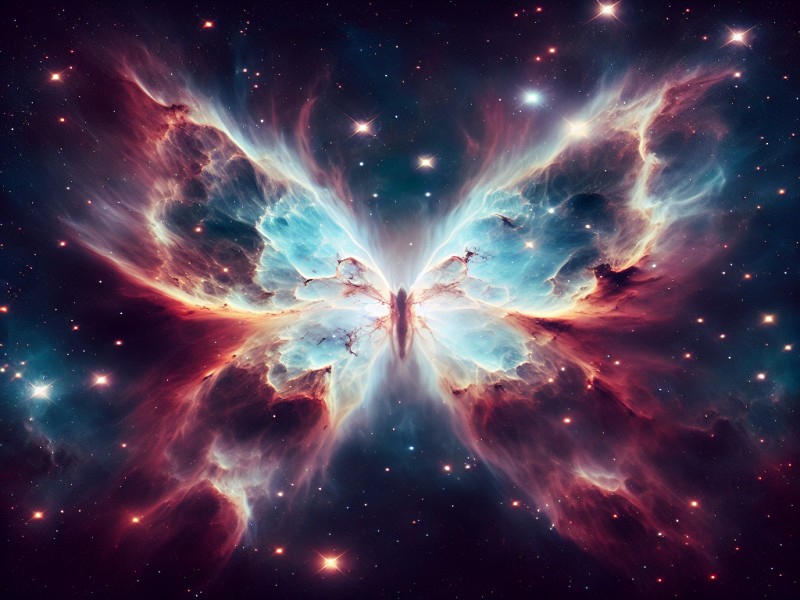
Article image generated by artificial intelligence
Stars are born as a result of gravitational compression of molecular gas clouds, but they eject some of the material in the form of narrow fast jets or broad, slower flows. These ejections interact with the surrounding environment, creating complex structures, as seen in the case of LBN 483.
Until 2022, astronomers believed that there was only one star inside the nebula, but observations using the ALMA telescope revealed that the system consists of two protostars. They are surrounded by a dense cloud resembling a giant dust donut, from which they continue to draw material for their growth. Meanwhile, the excess material is periodically "erupted" by the stars, leading to the formation of visible flows.
The image shows intricate details of these ejections: the bright orange arc is a shock wave created during the interaction of the flow with the surrounding material, while the light-purple pillars are dense clumps of gas and dust that the ejections have not yet destroyed. ALMA observations also showed that the magnetic field at the center of the nebula plays a crucial role in shaping its structure.
Studying objects like LBN 483 helps scientists better understand the processes of star formation, including the formation of the Sun 4.6 billion years ago. Perhaps one day extraterrestrial astronomers observed its birth, just as we now watch the emergence of new stars in the distant corners of the Universe.
We and selected third parties use cookies or similar technologies for technical purposes and, with your consent, for other purposes (“basic interactions & functionalities” and “measurement”) as specified in the Cookie policy.
You can freely give, deny, or withdraw your consent at any time.
You can consent to the use of such technologies by using the “Accept” button. By closing this notice, you continue without accepting.
 TGLIST.COM.UA
Comments
No comments
Add Comment