Artificial Intelligence
I/O 2026: Google's AI Shift, Codex Upgrades & Gaming News
6 min read
24.05.2026
Exclusive I/O 2026 interview with Sundar Pichai, Codex upgrades, agent CLIs, worker protections, and the latest gaming news in AI.
Good morning, {{ first_name | AI enthusiasts }}
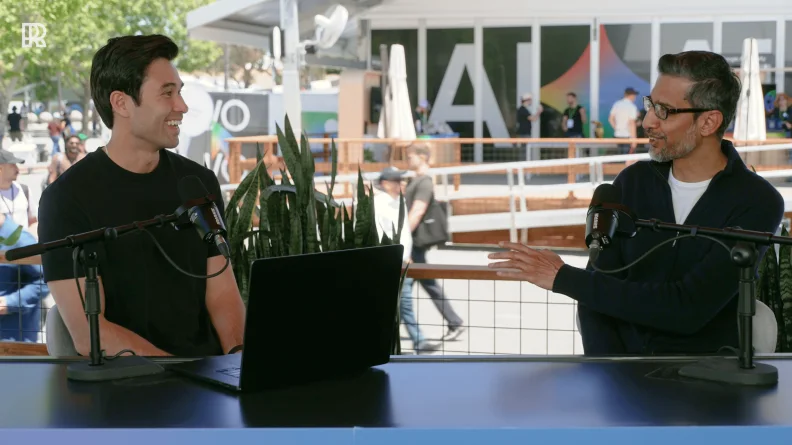
Google's announcements at I/O 2026 clarified the company's direction: a top-to-bottom push to make everyday life easier with AI. We sat down with Sundar Pichai, CEO of Google, to unpack what this shift means for creators, engineers, and regular users. Our conversation covered YouTube, agentic coding, and why today's AI may feel as primitive as a flip phone in three years.
In today's AI rundown
- Exclusive insights from Sundar Pichai at I/O 2026
- OpenAI's latest Codex upgrades
- How to generate an agent-native CLI from any website
- California's executive order to protect workers affected by AI
- 4 new AI tools, community workflows, and more — including gaming news
Google: Exclusive insights from Sundar Pichai at I/O 2026
Sundar Pichai: "Agents will be everywhere in three years — today's tech will look like flip phones."
We interviewed Google CEO Sundar Pichai about the company's AI push, its plans for YouTube creators, and what everyday AI will look like in the near future. Below are the key takeaways and why they matter.
Key takeaways
- Creator empowerment: Models like Gemini and Omni aim to help creators express themselves more effectively. YouTube will stay creator-first, preserving the human-to-human connection.
- Everyday integration: Pichai emphasized seamless integration: agents that handle tasks across devices and run 24/7.
- Agentic coding: Engineers will manage teams of agents that handle long-running tasks. Success metrics will shift from lines of AI-written code to how well agents orchestrate complex workflows.
Why it matters: Google believes that native fluency with AI tools will become essential for creators, coders, and general users. Adopting these tools early will shape creative workflows, developer productivity, and product experiences.
Sponsored: Building a foundation for AI-powered search (Algolia)
Algolia published a white paper on building a production-ready AI search stack. It covers the technical foundation every team needs to scale AI search reliably.
What the guide covers
- Ingestion, enrichment, and hybrid indexing for better retrieval
- RAG interfaces that connect your data to LLMs
- Observability and governance using secured API keys
- Lifecycle management as search needs evolve
OpenAI: Codex upgrades improve agentic assistants
OpenAI rolled out new Codex features that expand context access and enable longer-running goals. These upgrades are aimed at helping developers and teams work more efficiently with agentic assistants.
Notable features
- Appshots: Mac users can attach app windows (screenshot, text, content) to a Codex thread via a Command-Command shortcut.
- Goal mode: Available in the Codex app, IDE extension, and CLI. Set a long-running goal and let Codex work on it for hours or days.
- Locked computer use: Trigger Codex from a second device to use desktop apps even when the Mac is locked.
- Advanced annotation: Describe desired changes to a webpage; Codex previews the result instantly.
Why it matters: These features give agents richer context and longer horizons to act, narrowing the gap with competitors and improving developer workflows.
AI Training: Generate an agent-native CLI from any website
Want to build agent-friendly command-line tools for sites with limited APIs? Use Printing Press to generate CLIs and accelerate agent access to public data sources like flight sites or sports pages.
Step-by-step
- Visit the Printing Press repo and review examples or the GitHub install notes.
- Install the starter kit:
npx -y @mvanhorn/printing-press install starter-pack.
- Tell your agent (Codex/Claude Code/Hermes) to inspect the starter kit, list tools, read help output, and try a safe read-only command.
- Install the Printing Press binary:
go install github.com/mvanhorn/cli-printing-press/v4/cmd/printing-press@latest.
- Ask your agent to generate read-only commands for a public-data site, propose useful commands, then generate and test them.
Pro tip: If your agent struggles with an MCP or integration, instruct it to build commands with Printing Press. You'll need an API key for some sites.
Presented by AWS Marketplace: Your AI agents need a control plane
Multi-agent systems commonly fail without an orchestration layer: state loss between steps, missing human approvals, and silent failures. AWS presented a workshop on building a control plane to prevent these issues.
Workshop highlights
- Use AWS Step Functions to manage state and retries
- Coordinate reasoning and tool use with Amazon Bedrock Agents
- Add human approval gates to pause execution for sign-off
- Handle multi-step pipeline failures with Amazon MWAA
AI protections: California moves to protect workers
California orders agencies to study AI's job impact and propose policies to protect workers.
Governor Gavin Newsom signed an executive order directing state agencies to develop policies for workers affected by AI-driven job changes. The move comes right after Meta cut 8,000 jobs amid AI investments.
Key actions and timeline
- Within 90 days: Launch a public dashboard tracking AI's job impact
- Within 180 days: Propose WARN Act updates to speed up layoff alerts
- By Oct. 15: Review union negotiations, update workforce training, and explore channeling AI revenues to public benefit
Why it matters: California hosts many top AI companies. This policy work could set national precedents for severance, worker ownership models, and retraining as AI adoption accelerates.
Trending AI tools and gaming news
New and notable tools this week, plus gaming news relevant to AI and creators:
- Scrunch: Audit how AI interprets your site and unlock new ways to reach customers.
- NanoClaw: A secure, lightweight, open-source alternative to OpenClaw.
- Antigravity: Google's next-gen agentic development platform.
Gaming news: As AI tools improve content creation and personalization, game studios and streamers are increasingly using agentic assistants to generate game assets, highlight reels, and community engagement — a trend to watch closely.
Everything else in AI today
- Figure AI co-founder Brett Adcock's Hark raised $700M at a $6B valuation for personal intelligence systems.
- Anthropic is reportedly considering Microsoft's Maia chips after similar deals with Google and Amazon.
- Agentic AI startup Manus may raise about $1B as it navigates regulatory and acquisition issues in China.
- SpaceX's IPO filing shows Anthropic pays $1.25B per month for compute access through 2029.
- Microsoft and EY formed a $1B partnership to accelerate enterprise AI projects using engineers and consultants.
Community AI workflow
Each newsletter highlights a reader workflow. Today's example comes from Loïc R. in London, who used ChatGPT as a personalized coach to prepare for a 5-hour multi-sport event while minimizing injury risk after past ACL tears.
Process: Loïc asked for a custom 4-week program, recorded voice notes after runs, and let ChatGPT adjust the plan in real time. Outcome: A tailored training plan that maximizes readiness while reducing injury risk.
How do you use AI? Tell us here.
Sign-off
See you soon,
Rowan, Joey, Zach, Shubham, and Jennifer — the humans behind The Rundown
 TGLIST.COM.UA
Comments
No comments
Add Comment