Tech
Bezos: Bottom Half Should Pay Zero Income Tax
4 min read
24.05.2026
Jeff Bezos says Americans in the bottom half of earners should pay no federal income tax, sparking debate about wealth, unrealized gains and government spending.
Jeff Bezos Says Low-Income Americans Should Pay No Federal Income Tax
In a CNBC interview on Wednesday morning, Jeff Bezos argued that Americans in the bottom half of income earners should not pay federal income tax. He pointed to an example of a nurse in Queens making roughly $75,000 a year and paying about $1,000 a month in taxes.
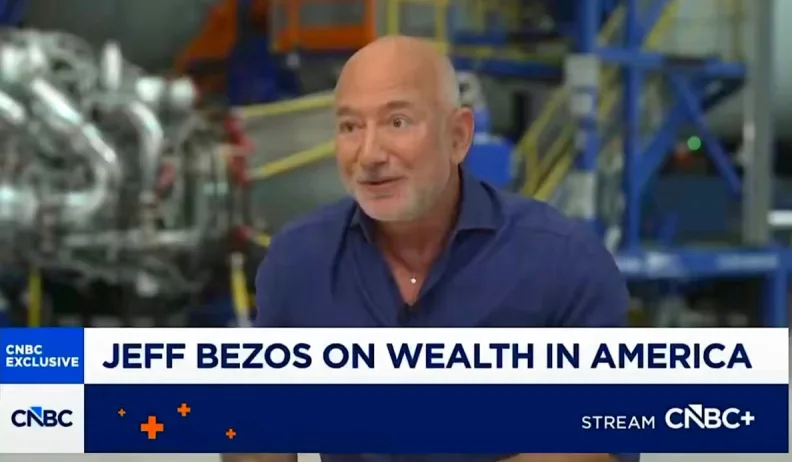
"Why is a nurse in Queens who makes $75,000 a year paying more than $1,000 a month in taxes? That's $1,000 that could help with rent, or groceries, or anything… To me, it's kind of absurd that we're doing this. We shouldn't be asking this nurse in Queens to send money to Washington. They should be sending her an apology."
Bezos' Argument: The Bottom Half Pays Very Little
Bezos says the bottom 50% of earners contribute only about 3% of total federal taxes. He estimated that people in that group devote roughly 16% of their salary to taxes — money he says barely affects federal revenue but makes a big difference for those households.
His point: small-dollar taxpayers are strained by immediate bills like rent, groceries, childcare, and medical expenses, while their contributions don't substantially change federal spending outcomes.
Context: Wealth, Taxes, and Unrealized Gains
This moment of empathy stands out from Bezos, one of the world's wealthiest people. Billionaires often pay low effective tax rates because the U.S. taxes realized income, not unrealized capital gains. If a stock increases in value but isn't sold, the owner typically does not owe income tax on that unrealized gain.
- ProPublica reported that from 2006 to 2018 Bezos' wealth rose by about $127 billion while he reported roughly $6.5 billion in income over that period.
- That reporting led to headlines showing a very low effective tax rate in some years despite massive increases in net worth.
- The ultra-wealthy often borrow against stock holdings to fund purchases. Loans are not taxed as income, so this strategy can delay or reduce immediate tax liability.
Responses and Tensions
When CNBC's Andrew Ross Sorkin referenced Senator Elizabeth Warren's critique — that some very wealthy people pay lower tax rates than high-earning wage workers — Bezos acknowledged the point but framed the issue differently.
"We already have the most progressive tax system in the world," Bezos said. "The top 1 percent of taxpayers pay 40 percent of all the tax revenue. The bottom half pay only 3 percent."
Bezos also said that simply taxing him more wouldn't necessarily solve perceived government inefficiencies. He suggested the U.S. has a spending problem rather than a revenue problem and questioned whether extra revenue would be well spent.
What Would Higher Taxes on Billionaires Do?
Critics say higher taxes on the ultra-wealthy could fund public goods that directly benefit middle- and lower-income families — for example:
- Improved public transit, making commuting more reliable and affordable.
- Better-funded public schools with sufficient supplies and staff.
- Expanded access to health care or reduced emergency medical costs.
Supporters of increased taxation argue even a small percentage of billionaires' wealth, if collected reliably, could meaningfully enhance local and national services. Opponents counter that without reforms to how money is spent, more revenue may get lost in bureaucracy.
Why This Matters to Everyday People
For many households, taxes are a tangible, regular deduction from paychecks that must cover immediate needs. The debate over taxing unrealized gains and closing loopholes centers on fairness and whether the tax code reflects the modern economy — where wealth can balloon through stock appreciation rather than traditional wages.
Whether you agree with Bezos or not, his comments reopened conversations about progressive taxation, wealth inequality, and how to balance tax policy with efficient, effective government spending.
Related Topics
- Tax policy and capital gains taxation
- Wealth inequality and effective tax rates
- Government spending priorities and public services
- Recent coverage in gaming news that touches on corporate taxation and revenue models (for broader context on how taxation and regulation can affect large companies and consumer-facing industries)
Amanda Silberling is a senior writer at TechCrunch and covers technology and culture. She has written for Polygon, NPR, Business Insider and others. You can contact her at [email protected].
 TGLIST.COM.UA
Comments
No comments
Add Comment