Tech
TechCrunch Mobility: Rivian R2, robotics and robotaxi moves
5 min read
22.03.2026
Latest mobility news: Rivian R2 reveal, Mind Robotics $500M raise, Lucid robotaxi concept, and robotaxi partnerships shaping the future of transport.
Welcome back to TechCrunch Mobility
Your central hub for news and insights on the future of transportation. To get this in your inbox, sign up here for free — just click TechCrunch Mobility.
This newsletter was wrapped and ready to go when Travis Kalanick pulled a 2016-level shock: the former Uber CEO is back building robotics company Atoms and revealed he is the largest investor in Pronto, an autonomous-vehicle startup focused on industrial and mining sites founded by Anthony Levandowski. Kalanick's move recalls 2016, a hyped year for AVs when Uber bought Levandowski's Otto and quickly faced a trade-secret lawsuit from Waymo.
Rivian R2: SXSW reveal and what we learned
I'm in Austin for SXSW, where Rivian — the headline sponsor — used the festival to share pricing and specs for its R2 SUV. I'm still interviewing company leaders (including CEO RJ Scaringe), but here's what we know so far.
Pricing and launch cadence
- The performance Launch Edition will start at $57,990.
- The long-promised $45,000 model won't arrive until late 2027.
Product positioning and marketing
Rivian is leaning into experiential marketing targeted at its core customers — the affluent, design- and tech-forward crowd common at SXSW. The R2 feels more approachable than Rivian's larger R1 truck and SUV, and Rivian is using the event to build demand ahead of a rapid launch.
Key hardware and software improvements
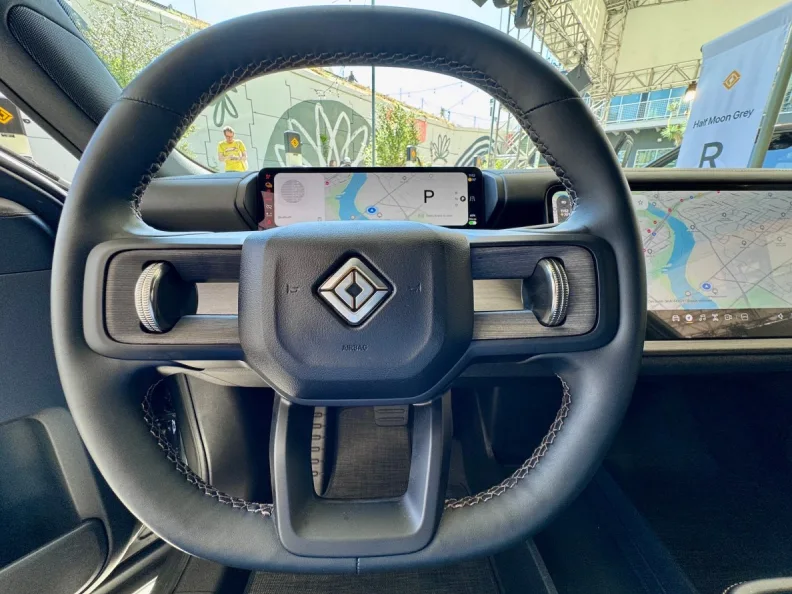
- Edge computing: The R2 uses a single system-on-chip (SoC) to run infotainment and on-edge workloads at about 200 TOPS (tera operations per second). That contrasts with the next-gen R1 architecture, which uses four SoCs and relies more on cloud computing.
- Local AI: Rivian's head of software, Wassym Bensaid, says edge compute enables running large language models locally, lowering latency and improving performance for in-car experiences.
- Halo wheels: New haptic "halo" controls on the steering wheel let drivers change temperature, fan speed, and volume quickly without looking away from the road. The company can expand these functions via software updates.
"Edge computing lets us run large language models locally, which provides much lower latency and better performance." — Wassym Bensaid, Rivian
Startup spinouts, funding and robotics
Rivian also spun out Mind Robotics, an industrial robotics lab that raised a $500 million Series A co-led by Accel and Andreessen Horowitz. Combined with a prior $115 million seed round, Mind Robotics now has an approx. $2 billion valuation.
At SXSW, RJ Scaringe argued companies often overcomplicate robot design by mimicking human biomechanics. He emphasized that in many industrial tasks the priority is to position the robot's hands precisely rather than build complex whole-body motion.
News bites and M&A
- inDrive acquired Pakistan quick-commerce startup Krave Mart in an all-stock deal approved by the Competition Commission of Pakistan.
- Mirai Robotics (Italy) raised $4.2 million for autonomous maritime systems.
- Surf Air ordered 25 Beta Technologies ALIA all-electric aircraft with options for 75 more.
Notable reads and industry updates
- MIT researcher Bryan Reimer asks whether automated vehicles will face a political divide similar to EVs.
- Archer Aviation counterclaimed against Joby Aviation, alleging false claims about being American-made — a reminder that the electric air sector can get litigious.
- Group14 started production of silicon battery materials in South Korea, with capacity for 2,000 metric tons annually (about 10 GWh of energy storage).
- Hayden AI sued its co-founder and former CEO over alleged misconduct and misuse of funds.
- The FAA approved eight pilot programs, letting companies like Archer, Beta, Joby and Wisk begin expanded electric aircraft testing across 26 states this summer.
- Harbinger revealed a second, smaller medium-duty work truck.
- Lucid added Apple CarPlay and Android Auto to Gravity SUV owners.
- The NTSB found two fatal crashes involving Ford's BlueCruise were likely linked to driver distraction.
- Nuro is testing autonomous delivery tech in Japan.
- Slate Auto (backed by Jeff Bezos) named Peter Faricy CEO ahead of production; former CEO Christine Barman becomes president of vehicles.
- Tesla became an officially licensed utility in the U.K.
Robotaxis and partnerships
- Wayve will partner with Uber and Nissan to pilot robotaxis in Tokyo in late 2026.
- Uber added Motional's Hyundai Ioniq 5 self-driving vehicles to its Las Vegas network; safety operators remain on board for now.
- Zoox began street mapping in Dallas and Phoenix and will make its robotaxis hailable on Uber in Las Vegas. Zoox still needs an exemption from FMVSS for commercial deployment because its vehicles lack conventional controls like a steering wheel.
Lucid's robotaxi concept
Lucid Motors showed a robotaxi concept on its midsize EV platform during investor day. Interim CEO Marc Winterhoff called it a dedicated project, but the company later said the vehicle is only a concept and isn't in active development. Sources say the project started just two to three months ago, so a production timeline remains unclear.
Chevy Bolt comeback — and a marketing idea
General Motors revived the Chevy Bolt EV. Senior reporter Tim De Chant likened the Bolt to the McRib — a quirky, nostalgia-driven product comeback. De Chant dug into the economics behind GM's decision and the potential sales psychology driving the return.
Got a tip?
Email Kirsten Korosec at [email protected] or message her on Signal at kkorosec.07. You can also email Sean O'Kane at [email protected].
Why this matters
The mobility landscape is converging: electric vehicles, robotics, autonomous systems and even gaming news about in-car entertainment and LLMs are reshaping what transportation looks like. Expect more cross-industry moves, faster product cycles, and ongoing legal and regulatory battles as companies scale.
 TGLIST.COM.UA
Comments
No comments
Add Comment