Tech
Read AI launches Ada: email-based AI assistant
4 min read
01.03.2026
Read AI launches Ada, an email-based AI assistant that schedules meetings, answers knowledge queries, and drafts replies while protecting sensitive data.
Read AI launches Ada: an AI email assistant that manages schedules and replies
Meeting notetaker Read AI on Thursday launched an AI-powered, email-based assistant called Ada. The assistant helps users manage schedules, answer questions using company knowledge, and reply to out-of-office messages. Read AI calls Ada a "digital twin" that works around the clock to handle routine tasks.
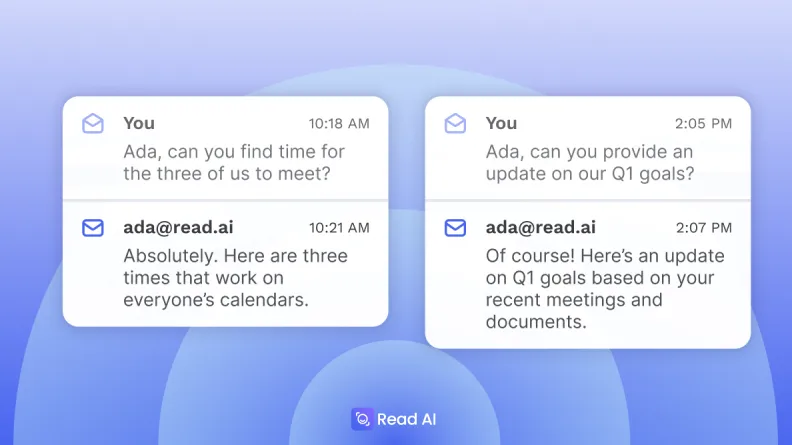
Users can enable and configure Ada by emailing "[email protected]" with the message "Get me started." The company says Ada will be available to all users and will expand to additional platforms soon.
How Ada schedules meetings
When asked to find a time, Ada sends your availability to the other person in the email thread. If the recipient requests different times, Ada replies with new options. Ada accesses your Read AI calendar to check availability but does not disclose details about your meetings.
Information and context: knowledge base, meetings, web
Ada answers questions using a company's internal knowledge base, topics discussed in prior meetings, and public web searches. For example, you can ask: "Ada, can you provide an update on how we are tracking for Q1 goals?" and receive a summary based on available data.
Drafts, approvals and sensitive data
If someone else asks a question in a thread, Ada prepares a draft response for you and helps refine it before sending. Read AI says the assistant won't reveal sensitive information without explicit permission.
"When you add Ada to your workflow and connect more services to give more context, it starts to ramp up and handle more tasks for you." — CEO David Shim
Technical approach and proactive assistance
Read AI's VP of Product, Justin Farris, explained that Ada doesn't rely on MCPs (Model Context Protocols). Instead, the assistant builds a knowledge graph from meeting data and connected services to deliver more contextual answers. Over time, Ada will take proactive actions. For instance, if you mention a follow-up item in a meeting, Ada can prompt you to set it up and include relevant context.
Platform rollout and user growth
Ada currently works via email, with Slack and Teams support planned soon. At Web Summit Qatar earlier this month, CEO David Shim told TechCrunch the company has over 5 million monthly active users and aims to reach 10 million. Read AI sees roughly 50,000 sign-ups daily and a broader audience of about 100,000 people who consume meeting summaries without creating accounts.
Although 60% of Read AI's users are outside the U.S., revenue is split roughly equally between U.S. and international markets.
Product expansion and competitors
Read AI has raised over $81 million and continues to add AI tools. Recent additions include Search Copilot for knowledge discovery, the ability to update customer-service software, send customized emails from meeting reports, and track topics using internal and web knowledge.
Other meeting notetakers are building similar capabilities. For example:
- Granola added "recipes" last September: repeatable prompts that surface knowledge from meeting data.
- Quill, which recently emerged from stealth with $6.5 million in funding, connects to tools like Linear, Notion, and CRMs to automate tasks.
Why this matters for professionals
Ada aims to save time on scheduling, follow-ups, and knowledge retrieval. Teams that rely on frequent meetings can use Ada to reduce administrative overhead and centralize meeting context. This can be especially useful for product managers, customer success teams, and remote-first companies that need a consistent source of meeting insights.
Note on sources
Reporting by Ivan Mehta at TechCrunch contributed to this article. You can contact or verify outreach from Ivan via email at "[email protected]" or via Signal at "ivan.42".
Related coverage tip: For readers also interested in gaming news, AI assistants like Ada may be adopted by esports teams and studios to coordinate schedules, track development milestones, and summarize playtest sessions.
 TGLIST.COM.UA
Comments
No comments
Add Comment