Gaming
Red Bull's Playable Tetris Magazine
3 min read
01.03.2026
Red Bull and Kevin Bates created a flexible, paper-thin playable Tetris cover for The Red Bulletin—a novel blend of print and gaming news.
Red Bull and Tetris turn a magazine into a playable game
Tetris has shown up on plastic chicken nuggets, fake Slurpee cups, and wristwatches. But Red Bull and Tetris Company's latest collaboration turned a magazine cover into a genuinely playable handheld. The limited edition of The Red Bulletin included a flexible, paper-thin Tetris game built with custom flexible electronics.
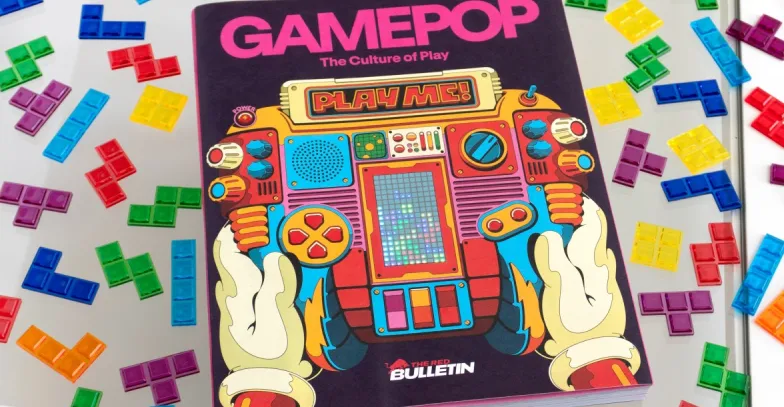
How the playable magazine was made
Red Bull Media House worked with hardware designer Kevin Bates, known for tiny Tetris devices like an ultra-thin business card player and the Arduboy handheld. Bates spent much of the previous year developing what the team calls the GamePop GP-1 Playable Magazine System.
The design relies on a mix of flexible and rigid components to keep the cover thin yet functional:
- Flexible LED matrix: The display uses 180 tiny 2mm RGB LEDs mounted on a flexible circuit board about 0.1mm thick. Bonded between paper sheets, the matrix bends and flexes like the rest of the cover.
- Capacitive touch controls: To avoid bulky mechanical buttons, seven capacitive touch sensors are printed in the copper layer of the flexible board. The paper's slight flex gives tactile feedback when pressed.
- Thin rigid PCB: A narrow rigid board at the spine houses an ARM-based 32-bit microprocessor and four rechargeable LIR2016 coin cells, balancing durability with thinness.
- USB-C charging: A deconstructed USB-C port hides in a paper pocket along the bottom edge, allowing recharging without replacing the batteries.
Design trade-offs and durability
Flexible circuits are not new, but falling costs and greater accessibility have let independent makers use them in novel ways. Bates adapted what he'd learned from prior pocket devices to produce a playable element that can survive being handled like a magazine.
"I hit it with a hammer a few times," Bates said. The display survived where folding-phone OLEDs might not.
To keep the cover thin, the team traded some modern Tetris features for simplicity and battery life. The playable cover saves high scores but omits features like next-piece previews and piece holding. Sound is limited to a short Tetris theme excerpt and compact piezo effects, which are intentionally low-power. Bates says active play lasts about one to two hours; idle battery life stretches across months.
What it feels like to play
The experience isn't meant to replace full-size handhelds, but it delivers a surprising amount of playability for something embedded in paper. The LED matrix provides clear, readable blocks. The capacitive sensors, tuned to the magazine's paper thickness and glues, are responsive enough for casual play. It's not for chasing world records, but it's an impressive novelty that blends print and gaming in a new way.
Availability and production
Red Bull produced about 1,000 copies of the gaming edition of The Red Bulletin. Only 150 copies featured the fully playable cover; those were not sold but distributed to tournament participants, featured contributors, influencers, and select media. The general run sold online in Europe and appeared at some specialty retailers, including Iconic Magazines in New York and Rare Mags near Manchester.
Why this matters for gaming news and tech
While the playable cover won't revolutionize the print industry or produce rollable smartphones, it demonstrates how existing components can be recombined to create new experiences. For gaming news, this project highlights how hardware makers and media companies can collaborate to produce tactile, shareable products that drive interest and coverage.
The GamePop GP-1 project is a practical showcase of flexible electronics, low-power design, and creative product thinking—and it gives readers a memorable way to interact with a magazine.
Photography by Andrew Liszewski / The Verge
 TGLIST.COM.UA
Comments
No comments
Add Comment