Artificial Intelligence
AI-in-the-Loop: Agents, Security, and Ownership
5 min read
01.03.2026
DJ Sampath on agentic workforces, AI readiness, security risks, and why companies should own intelligence—not rent it.
Good morning, {{ first_name | AI enthusiasts }}
AI is often called a "digital teammate," but integrating AI into core workflows reshapes how teams operate and raises important questions: What gets faster? What becomes riskier? Where must humans stay in control?
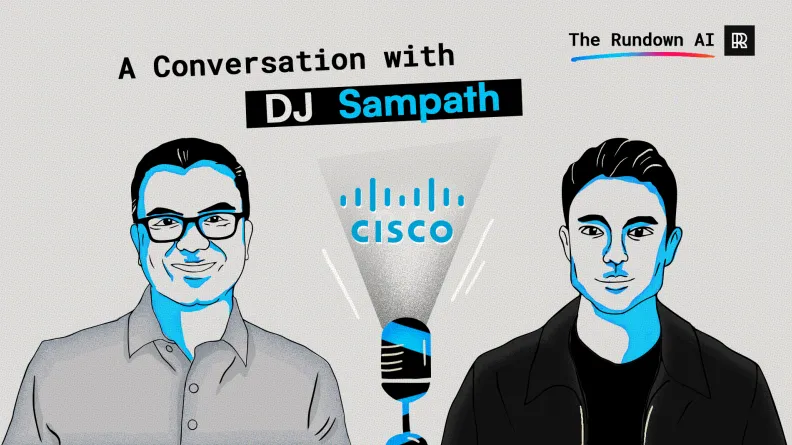
To explore these shifts, we spoke with DJ Sampath, SVP of AI Software and Platform at Cisco, at the Cisco AI Summit. He shared practical guidance on building, securing, and scaling AI-in-the-loop systems.
In today's AI rundown
- The rise of an agentic workforce
- Sampath's structured, multi-model workflow
- Rethinking AI readiness from the ground up
- Today's biggest AI security risk
- Why intelligence should be owned, not rented
AGENTIC SHIFT: The rise of a new agentic workforce
The Rundown: Cisco frames AI agents as a digital workforce that absorbs routine tasks—such as resolving outages—so human teams can focus on strategic and creative work. The company sees success hinging on mastering human–agent collaboration.
Key takeaways from DJ Sampath
"For the first time, we're deploying digital teammates that can plan, reason, and execute with autonomy."
Sampath predicts that within 12 months, about 80% of pattern-based, routine network incidents could be resolved autonomously by AI. The remaining 20%—multi-vendor issues, legacy systems, and edge cases—will take longer. Like self-driving technology, progress will compound over time.
Over five years, organizations that design for trust, governance, and intent in human–agent collaboration will define the next era of operational performance.
Why it matters
Humans won't be replaced; they'll move up the stack into roles that demand judgment, creativity, and strategy. The competitive edge will come from pairing human depth with agents' speed and scale.
DJ'S WORKFLOW: Sampath's structured, multi-model approach
The Rundown: Sampath uses multiple AI tools in a disciplined workflow—from ideation to critique to execution—plus persistent context storage to build a compounding knowledge base.
Practical steps he follows
- Separate idea generation from evaluation: draft in one model, critique in another to avoid confirmation bias.
- Store context in markdown using tools like Cursor: folders and files become a long-term thought partner that recalls frameworks and past work.
- Connect AI to calendars and meeting notes to prep for conversations with partners, customers, and analysts.
- Use coding agents to automate recurring tasks: daily briefs, product reviews, and document analysis.
Why it matters
This approach turns one-off AI interactions into a system that improves over time. Teams that stitch together models, agents, and systems into structured workflows will gain sustained productivity gains.
AI READINESS: Rethinking readiness from the ground up
The Rundown: Many enterprises aren't held back by ambition but by infrastructure debt and siloed data. The solution pairs modern infrastructure with leadership clarity and embeds intelligence into products.
What's blocking adoption
- Legacy networks and fragmented data
- Siloed tooling that can't handle high-throughput or real-time processing
- Lack of governance, strategy, and alignment to business outcomes
Sampath's prescription
Companies should modernize the stack and embed intelligence directly in products. When models train on contextual enterprise data, they create closed feedback loops that continuously improve outcomes—turning the product into the model and the model into the product.
Why it matters
Being AI-ready requires rethinking infrastructure, security, and applications together. Firms that make AI core to their offering can unlock proprietary-data-driven feedback loops that speed innovation.
AI SECURITY: Today's biggest AI security risk
The Rundown: The most urgent threat is agent compromise. As agents access data, invoke tools, and make decisions, they become new attack surfaces that adversaries can target.
Immediate risks
Compromised agents can be hijacked, impersonated, or manipulated to exfiltrate data or execute unauthorized commands at machine speed. Attackers are already probing these vulnerabilities.
How to secure agentic systems
- Harden agent infrastructure first: protect the protocols that connect agents to tools, data, and other agents.
- Adopt zero-trust identity and control over agent protocols and tool registries.
- Implement continuous behavioral monitoring of agents for anomalies.
- Keep humans in the loop for high-impact actions: privilege changes, production deployments, access to sensitive data, and irreversible actions should require human authorization.
"The right model isn't human-out-of-the-loop. It's AI-in-the-loop."
Treat agents like real entities: give them identity, guardrails, and constant oversight.
THE AI COMPANY THESIS: Why intelligence should be owned, not rented
The Rundown: Simply adding a generative API to a product is not a long-term strategy. Sampath argues the moat comes from embedding intelligence into products and owning the models that drive them.
Core idea
A thin shim on top of an external model is a fragile business model. Sustainable advantage comes when the model is trained on proprietary machine and enterprise data and continually improves product outcomes.
What ownership looks like
- Develop a full stack to fine-tune, deploy, and govern models in-house.
- Ensure data pipelines feed models with proprietary context to build a compounding moat.
- Design governance that balances autonomy with accountability.
Why it matters
Most enterprises today rent intelligence from centralized providers. Companies must decide whether they want AI capabilities that compound as assets—or ones they can lose if a provider changes terms.
Watch the Cisco AI Summit on-demand
See sessions featuring leaders like Sam Altman (OpenAI), Jensen Huang (Nvidia), and Mike Krieger (Anthropic Labs). Watch on-demand for detailed discussions on frontier models, infrastructure, and enterprise AI.
See you soon,
Rowan, Joey, Zach, Shubham, and Jennifer — the humans behind The Rundown
Note: This briefing covers enterprise AI trends relevant to many industries, including gaming news organizations looking to incorporate AI into content workflows, moderation, and personalized experiences.
 TGLIST.COM.UA
Comments
No comments
Add Comment