Tech
Mesh Optical Raises $50M to Scale Optical Transceivers
4 min read
22.02.2026
Ex-SpaceX engineers launch Mesh Optical to mass-produce transceivers for AI data centers, targeting 1,000 units/day and supply-chain resilience.
SpaceX Engineers Launch Mesh Optical Technologies to Mass-Produce Optical Transceivers
Three former SpaceX engineers — Travis Brashears, Cameron Ramos and Serena Grown-Haeberli — have founded Mesh Optical Technologies, a Los Angeles startup building optical transceivers for data centers and beyond. The company announced a $50 million Series A round led by Thrive Capital.
From Starlink to data-center hardware
The founders first worked together at SpaceX developing optical communications links that keep thousands of Starlink satellites in constant contact. While designing a new generation of compute-heavy satellites, they evaluated the optical transceiver market and identified clear gaps in performance, cost and supply-chain security.
"Someone will brag about a million GPU cluster; you have to multiply by four to five for the number of transceivers in that cluster," Brashears explained.
What Mesh makes and why it matters
Mesh designs and plans to mass-produce optical transceivers — devices that convert optical signals from fiber or laser into electrical signals for computers. These components are critical in modern data centers where multiple GPUs must communicate at very high speed to train and run large deep-learning models.
- Optical transceivers enable high-bandwidth GPU interconnects used in AI training clusters.
- They reduce latency and increase throughput compared with older copper solutions.
- One U.S. supplier, AOI, secured a $4 billion AWS contract last year, highlighting demand and market value.
Manufacturing goals and timeline
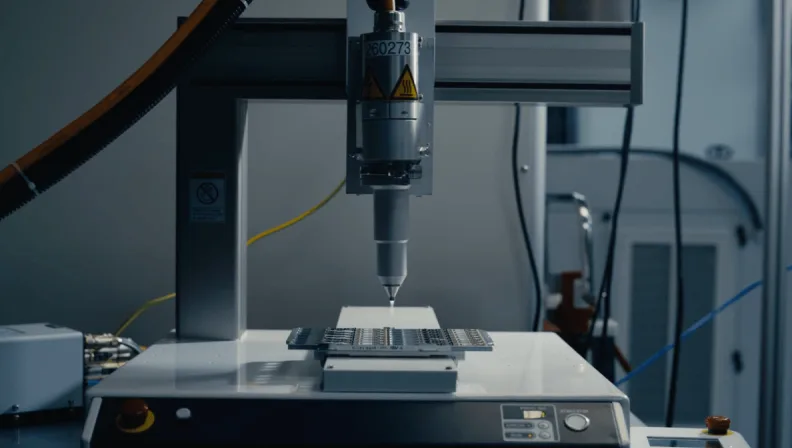
Mesh aims to produce 1,000 units per day within the year. Hitting that rate would allow the company to start qualifying for large-scale orders in 2027 and 2028. To reach those targets, Mesh plans to implement lights-out, automated manufacturing — a production style that minimizes human intervention and reduces variation.
Automated manufacturing expertise is concentrated in China, so Mesh hopes to differentiate by co-locating design and production in the U.S. This vertical integration could yield faster iteration, tighter quality control and lower overall costs.
Supply chain and national security considerations
The optical transceiver market is currently dominated by Chinese suppliers. Mesh and its investors frame their effort partly as a national-security play: ensuring critical AI data-center components are manufactured outside geostrategic rivals. Thrive Capital partner Philip Clark told TechCrunch that if AI is the most important technology in generations, relying on components from "misaligned/competitive countries" poses risk.
Product advantages and efficiency gains
Mesh's current design removes a commonly used but power-hungry component. According to Ramos, this change could reduce GPU-cluster power usage by 3%–5%. At hyperscaler scale, those savings translate into meaningful reductions in operating costs and carbon footprint.
Long-term vision: photonics beyond data centers
While Mesh is starting with data centers and AI infrastructure, the founders envision a broader shift from radio-frequency (RF) communications to photonics. They aim to "interconnect everything," not just computers, using optical wavelength communications as a next-generation communications paradigm.
"We want to be at the precipice of transition from RF to photonics…we want to interconnect everything, and not just computers, but that's where we're starting," Brashears told TechCrunch.
Challenges ahead
The founders acknowledge significant hurdles. Automated manufacturing at scale is uncommon in U.S. industry, and many European equipment suppliers still design processes with Chinese customers in mind. Mesh will need to prove manufacturing reliability, secure supply chains for materials, and win trust from hyperscalers and cloud providers.
Why this matters to the broader tech ecosystem
As demand for AI compute grows, so does demand for reliable, high-speed interconnects. Mesh's attempt to localize production and innovate on energy efficiency could influence supply-chain strategies for data centers and gaming news ecosystems where low-latency, high-bandwidth links matter for cloud gaming, multiplayer services and content delivery.
About the reporter
Tim Fernholz covers technology, finance and public policy. He has followed the private space industry closely and authored Rocket Billionaires: Elon Musk, Jeff Bezos and the New Space Race. Contact: [email protected] (or encrypted: tim_fernholz.21 on Signal).
 TGLIST.COM.UA
Comments
No comments
Add Comment