Tech
Rivian, AVs and sensor deals: mobility briefing
5 min read
22.02.2026
Rivian's R2, AV strategies from Uber and Lyft, and consolidation in perception sensors — plus the latest mobility and gaming news.
Welcome back to TechCrunch Mobility
Your hub for news and insights on the future of transportation. To get this in your inbox, sign up here for free — just click TechCrunch Mobility!
Earnings season: why it matters
We're in one of my favorite times of year: earnings season. These filings cut through marketing noise and reveal the real financial picture companies face. They also show short- and long-term stakes and help surface strategic shifts across the mobility industry.
Rivian: software and the R2 take center stage
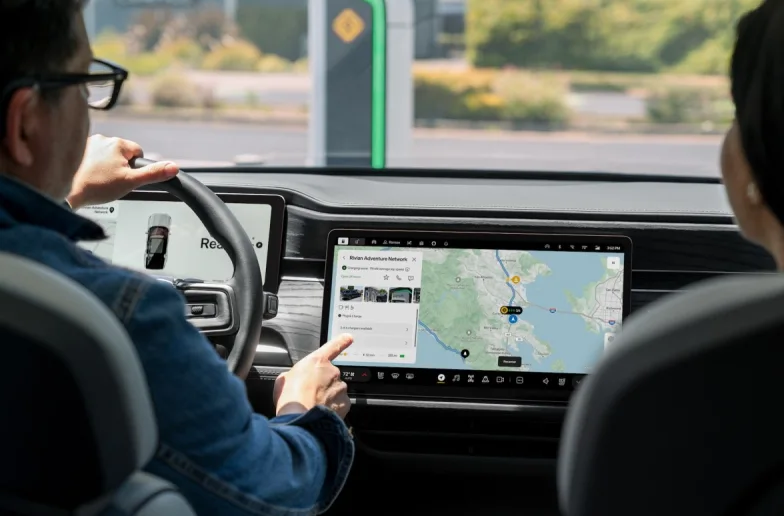
Rivian's fourth-quarter and full-year results delivered clarity. My main takeaway: software — and specifically the technology joint venture with Volkswagen Group — was the company's savior in 2025. That partnership is expected to deliver another $2 billion in 2026, providing a runway as Rivian launches its most important product to date: the lower-cost R2 SUV.
Cost improvements and production guidance
Rivian reported a drop in automotive cost of goods sold (COGS) per unit. The number fell to $100,900 in 2025 from $110,400 in 2024. In short: margins are improving, and the company is losing less on each vehicle it sells.
The upcoming R2 is designed to be substantially cheaper to build and cheaper to buy than the R1T and R1S. Production is expected in the first half of the year — analysts are hearing June — and Rivian's 2026 guidance suggests the company can ramp. Management expects 62,000 to 67,000 deliveries in 2026, a potential increase of up to 59% from its 42,247 deliveries in 2025 (which included two R1 consumer models and the electric delivery van, EDV).
Markets reacted strongly: Rivian stock jumped 27% the day after earnings.
A little bird: Uber, Lyft and AV strategies
Over the past 18 months, Uber and Lyft have drifted in different directions on autonomous vehicles (AVs). Uber is aggressively locking up AV partnerships across the globe. Lyft appears to be trailing behind.
Lyft's cash position and strategic choices
Insiders wonder why Lyft hasn't pushed harder into AVs, especially given its balance sheet. Lyft holds roughly $1.8 billion in cash, cash equivalents and restricted cash. The company recently announced a $1 billion share repurchase program — about 15% of its market cap. Some argue that Lyft could reinvest more into parts of the AV value chain instead of buying shares back.
Executive departures
- Aurélien Nolf left as VP of financial planning & analysis and investor relations to become CFO of Navan.
- Audrey Liu, former executive VP and head of rider and community safety, joined Adobe.
- Ameena Gill, ex-VP of safety and customer care, took a role at rival Uber.
Got a tip?
Email Kirsten Korosec at [email protected] or Signal at kkorosec.07. You can also email Sean O'Kane at [email protected].
Deals and consolidation in perception sensors
The lidar and sensor market has seen major churn since the 2015–2019 boom. Many buzzy lidar startups have folded, while others scaled through mergers and acquisitions.
Ouster's acquisitions and strategy
Ouster grew from a small CES booth presence to a larger player after its 2022 merger with Velodyne and its 2021 acquisition of Sense Photonics. Most recently, Ouster acquired Stereolabs — a maker of vision-based perception systems for robotics and industrial uses — for $35 million plus 1.8 million shares.
As consolidation continues, other recent moves include MicroVision purchasing lidar assets from the bankrupt Luminar for $33 million.
Why the activity?
The renewed focus on "physical AI" — integrating sensors, perception software, and edge compute — has reignited investment in cameras and other sensor tech. Companies are combining capabilities to build more robust perception stacks for vehicles, robotics, and industrial systems.
Other notable deals
- Ever, an EV-only marketplace, raised $31 million in a Series A led by Eclipse. Other backers include Ibex Investors, Lifeline Ventures, and JIMCO (the Jameel family investment arm).
- Natilus, developing blended-wing aircraft, raised $28 million in a Series A led by Draper Associates. Additional investors include Type One Ventures, The Veteran Fund, Flexport and several new backers.
Notable reads and tidbits
- Aurora reported its self-driving trucks can now go nonstop on a 1,000-mile route between Fort Worth and Phoenix — longer than a human driver can legally drive without rest. The company shared more details and financials in its Q4 and full-year reports.
- The SEC closed its investigation into Fisker last year, according to a FOIA request by TechCrunch.
- Lyft launched teen accounts, allowing riders as young as 13 to hail rides without an adult in 200 U.S. cities, including Atlanta, Boston, Chicago and New York.
- New videos show how Rivian changed the rear door manual release on the R2. This small design detail has safety implications amid industry pressure — especially after scrutiny of concealed electronic door handles.
- The Trump administration moved to repeal the EPA's 2009 "endangerment finding" for greenhouse gases. If the EPA proceeds, the change could affect tailpipe emissions rules for cars and trucks, though the process will likely face legal challenges.
Autonomy updates around the globe
- Uber has sealed dozens of AV partnerships. Baidu and Uber plan to launch robotaxis in Dubai soon, starting in the Jumeirah area.
- WeRide and Uber aim to deploy at least 1,200 robotaxis across the Middle East through 2027 and just launched a service in downtown Abu Dhabi.
- Waymo removed human safety drivers from tests in Nashville as it moves toward a robotaxi service. To solve a practical problem — ensuring doors close properly — Waymo is piloting a program paying DoorDash workers to close robotaxi doors in Atlanta.
- Waymo is rolling out its sixth-generation Waymo Driver, integrated into the Zeekr RT (branded Ojai) and eventually the Hyundai Ioniq 5. The company has started limited fully autonomous operations in San Francisco and Los Angeles for employees; public access will come later.
Rivian R2: what "more affordable" likely means
Rivian describes the R2 as a more affordable SUV. The company has cited base-price ranges around $45,000 to $50,000. Expect the initial launch edition — a premium dual-motor, all-wheel-drive trim — to cost more. In our newsletter this week, we asked readers to guess the launch-edition price.
Want to weigh in? Sign up for our newsletter to participate in polls and get the latest mobility and gaming news delivered to your inbox.
 TGLIST.COM.UA
Comments
No comments
Add Comment