Artificial Intelligence
OpenAI vs Anthropic: GPT-5.3 & Opus 4.6 Updates
5 min read
08.02.2026
OpenAI and Anthropic released major model updates — GPT-5.3-Codex and Claude Opus 4.6 — plus OpenAI Frontier and productivity tips for Claude in Excel.
Today's AI Rundown: OpenAI vs Anthropic — Models Do the Talking
Good morning, {{ first_name | AI enthusiasts }}. After Super Bowl attack ads yesterday, today's headlines belong to OpenAI and Anthropic. Both labs dropped major updates that push agentic coding, enterprise automation, and self-improving models forward. Things are moving faster than ever — and anyone saying "AI is hitting a wall" should probably sit this cycle out.
Top stories
- OpenAI launches GPT-5.3-Codex, a coding model that aided its own development.
- Anthropic releases Claude Opus 4.6 with multi-agent collaboration and a 1M token context.
- OpenAI unveils Frontier, a platform to manage AI agents as enterprise coworkers.
- Practical tips: using Claude in Excel to speed reporting and dashboarding.
Big-picture: Both releases accelerate how much work models can take on — from drafting code to running enterprise processes and even helping train their successors.
OPENAI: GPT-5.3-Codex helps build itself
The nutshell: OpenAI released GPT-5.3-Codex, a flagship coding model that combines advanced programming and reasoning. OpenAI also used early versions of 5.3-Codex to find bugs, manage rollout, and analyze evaluation results — a notable self-improvement loop.
Key details
- Codex topped agentic coding benchmarks like SWE-Bench Pro and Terminal-Bench 2.0.
- It beat Anthropic's Opus 4.6 by 12% on Terminal-Bench 2.0 shortly after release.
- On OSWorld, which tests AI control of desktop environments, Codex scored 64.7% — nearly double previous versions.
- OpenAI assigned a "High" cybersecurity risk rating to 5.3-Codex and committed $10M in API credits for defensive security research.
Why this matters
The self-improvement angle is the headline. Models contributing directly to their own testing and deployment shortens feedback loops and speeds capability gains. For developers and enterprises, that means faster iteration and more powerful automation tools.
ANTHROPIC: Opus 4.6 with 'agent teams' and 1M context
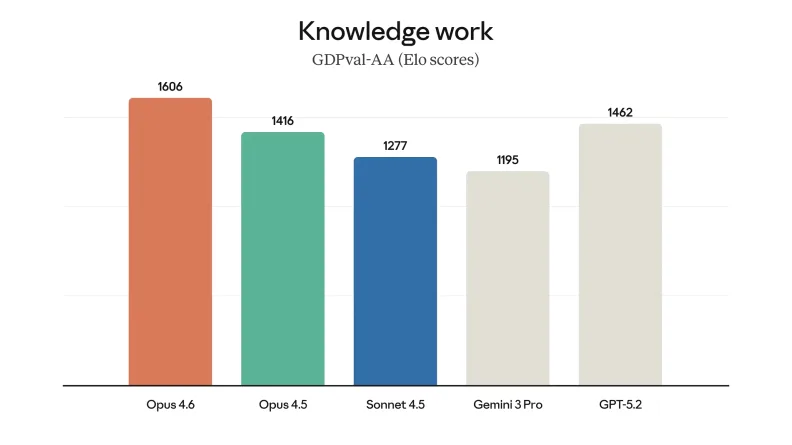
The nutshell: Anthropic's Claude Opus 4.6 introduces multi-agent collaboration inside Claude Code, a 1M token context window, and native Office integrations for PowerPoint and Excel.
Key details
- "Agent teams" let multiple AI agents split a project and work in parallel rather than sequentially.
- Opus 4.6 offers a 1,000,000-token context window for heavy-document and large-code tasks.
- New Excel and PowerPoint sidebars allow Claude to read templates and build models or decks without copy/paste.
- The model scored highly on agentic benchmarks, including a near 70% on ARC-AGI-2.
Why this matters
Opus 4.6 targets productivity for developers and knowledge workers. Longer context windows and agent teams make it easier to tackle large projects — from codebases to complex documents and slide decks. For teams, that reduces manual coordination and speeds delivery.
OPENAI FRONTIER: Manage AI 'coworkers'
The nutshell: Frontier is OpenAI's enterprise platform to deploy and manage AI agents like new hires. It provides onboarding, permissions, performance reviews, and integrations with existing systems.
Key details
- Frontier connects to CRMs, ticketing, and other enterprise tools so agents can pull context without data migrations.
- Built-in evaluation and feedback loops let agents learn through experience, similar to employee onboarding.
- Each agent has a profile, scoped access, and hard limits for security and compliance.
- Early adopters include HP, Oracle, State Farm, and Uber; OpenAI provides hands-on engineering support for deployments.
Why this matters
Model improvements are only part of the race. Orchestration layers like Frontier determine how companies actually adopt AI agents. Whoever owns that layer may capture significant enterprise value.
How-to: Cut reporting times with Claude in Excel
The nutshell: Use Claude's Excel add-in to clean data, standardize tabs, and build a master dashboard from multiple CSVs in minutes instead of hours.
Step-by-step
- Install Claude's Excel app from the Microsoft Marketplace.
- Open your spreadsheet (we used a year of SEO data; sales or receipts also work). Click the Claude button and prompt: "I have [data type] data from [sources] for my website/brand/team. Make a plan to rename each tab and clean the data up to make it more readable." Review and approve the plan.
- Ask Claude to propose a master dashboard: "Based on all tabs, what's the best way to tie this data into a Master Dashboard?" Approve and refine the layout.
- Ask Claude to create visualizations, e.g., "Create a combo chart for Clicks vs. Average Position."
Pro tip: Asking Claude to review and plan before executing improves results compared to immediate editing prompts.
Trending AI Tools & Ecosystem Moves
- GPT-5.3-Codex — OpenAI's SOTA agentic coding model.
- Claude Opus 4.6 — Anthropic's latest with agent teams and 1M token context.
- OpenAI Frontier — Enterprise orchestration for AI agents.
- Perplexity Model Council — Run queries across multiple models and synthesize answers.
Other notable updates:
- Roblox launched 4D generation through its Cube AI model to create interactive in-game objects from text prompts.
- Lotus Health raised $35M to expand free AI-powered primary care across 50 states.
- Meta is unbundling Vibes into a standalone AI video app.
- METR released analysis showing GPT-5.2 (high) can complete tasks that would take a human engineer over six hours.
Community Workflow
Each newsletter we spotlight a reader using AI to work smarter. Today's entry comes from T. in Canada:
"I use AI to source vendors for fresh produce and compare/predict market price changes from globally supplied goods. It helps to maintain food security in our northern region."
How do you use AI? Tell us here.
Why gamers and readers of gaming news should care
Though these releases focus on coding and enterprise, the ripple effects reach gaming news and game development. Faster agentic coding speeds up tool creation for game studios. Large-context models and agent teams can help manage massive game worlds, automate QA, and generate complex narratives. Expect more AI-driven mod tools, procedural content pipelines, and improved in-game assistants.
Quick takeaways
- OpenAI and Anthropic accelerated the agentic AI race with two major releases in one day.
- Self-improvement loops and agent orchestration are now central themes.
- Practical wins: tools like Claude in Excel make data work faster and repeatable.
- Gamers and developers should watch these advances — they'll shape tooling, content generation, and automation in games.
See you soon,
Rowan, Joey, Zach, Shubham, and Jennifer — the humans behind The Rundown
 TGLIST.COM.UA
Comments
No comments
Add Comment