It lay in a sealed capsule at a depth of 180 meters.
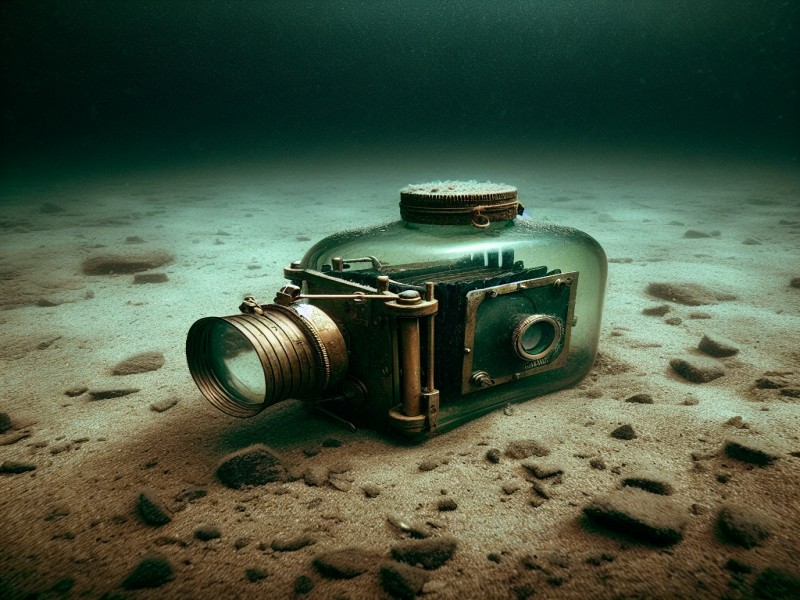
The underwater vehicle Boaty McBoatface, developed and operated by the UK's National Oceanography Centre (NOC), accidentally discovered an ancient camera trap based on the Kodak Instamatic 174 while studying the bottom of Loch Ness. It turned out that scientists had attempted to capture the mythical inhabitant of this body of water using it 55 years ago.
Article image generated by artificial intelligence
This was one of the first attempts to film the so-called Loch Ness Monster. The idea was initiated in 1970 by Professor Roy Mackal from the Loch Ness Research Bureau and the University of Chicago. This camera, found at a depth of 180 meters, was one of six camera traps submerged in special airtight containers. Three of them were lost that same year.
Since the camera had remained in a sealed capsule all this time, the film was practically unharmed. An NOC engineer was able to develop it and show what was captured 55 years ago.
Of course, no images of Nessie were found, nor was there anything that triggered the camera to take these photographs. However, it's quite impressive that the camera trap fulfilled its purpose and was restored after more than half a century.
It is also worth noting that the National Oceanography Centre of the UK, while deploying its research vehicles to depth, is not searching for any creatures. Scientists and engineers have merely been testing their robotics for endurance in Loch Ness for nearly ten years.
Sam Smith, an engineer at NOC Marine Autonomous Robotics Systems (MARS), stated: "At a depth of 230 meters, Loch Ness is the perfect place to test our robotics, its sensors, and systems before they are deployed in the deep ocean to help answer scientists' questions."
And although such a discovery was not part of the NOC engineers' plans, they are still pleased that this part of the history of the hunt for Nessie can be made public.
The film, camera, and its case were transferred to the Loch Ness Research Centre in the Scottish village of Drumnadrochit. There, this find will become a new exhibit and part of the rich history of the hunt for the mythical monster that began with the mysterious photograph of 1934.
We and selected third parties use cookies or similar technologies for technical purposes and, with your consent, for other purposes (“basic interactions & functionalities” and “measurement”) as specified in the Cookie policy.
You can freely give, deny, or withdraw your consent at any time.
You can consent to the use of such technologies by using the “Accept” button. By closing this notice, you continue without accepting.
 TGLIST.COM.UA

Comments
No comments
Add Comment