Organized traffic lanes become chaotic at a certain predictable moment.
In crowded corridors, people typically line up in orderly rows, while in open city squares, their movement becomes chaotic - they move in all directions and often change their trajectory. Scientists from the Massachusetts Institute of Technology decided to investigate why this happens.
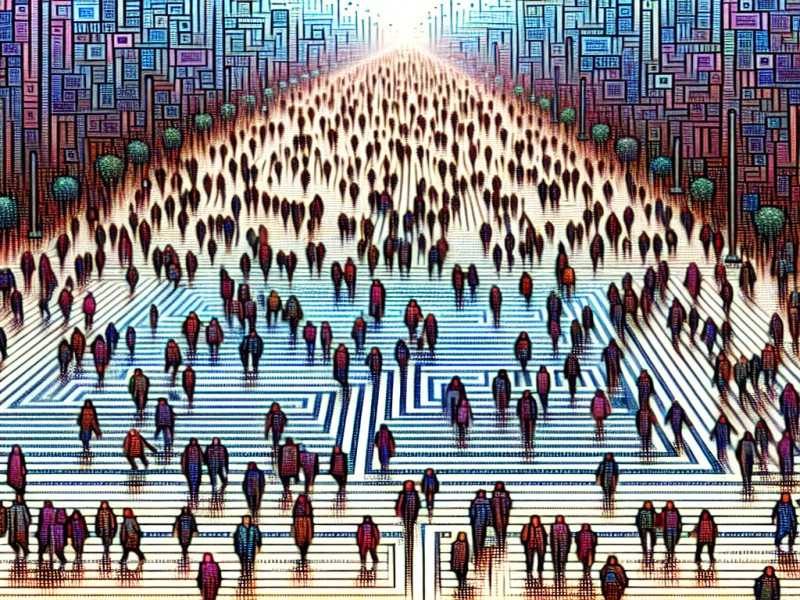
Article image generated by artificial intelligence
They developed a model capable of accurately predicting pedestrian flow behavior and determining the moment when organized traffic lanes transform into numerous trajectories. It was tested using simulations that replicate crowd movement in various spaces, applying hydrodynamic equations to analyze people's behavior in different scenarios.
It turned out that the width of the space and the angles at which people move significantly affect the overall order. However, a key factor is the "angular dispersion" - the number of people moving in different directions.
In areas with low angular dispersion, such as narrow corridors or sidewalks, pedestrians usually form lanes and move in opposite directions. In contrast, open spaces, such as squares or airport lobbies, greatly increase the likelihood of chaos, as people are forced to dodge each other and change their trajectory to reach their destinations. According to theoretical analysis, the critical value of angular dispersion is around 13 degrees.
To verify this conclusion, mathematicians conducted an experiment involving real people. Each volunteer was given a paper hat with a unique barcode and asked to walk through a gym from one designated point to another, avoiding collisions with other participants. Cameras installed on the ceiling recorded both individual pedestrians and the overall crowd movement.
The analysis of 45 conducted trials confirmed the significance of angular dispersion, demonstrating the transition from organized lanes to chaotic movement at angles close to the theoretically calculated 13 degrees. Furthermore, as chaos increased, pedestrians slowed their pace to avoid collisions - their speed decreased by approximately 30% compared to movement in organized lanes.
This work may help architects and urban planners design safer and more functional public spaces.
We and selected third parties use cookies or similar technologies for technical purposes and, with your consent, for other purposes (“basic interactions & functionalities” and “measurement”) as specified in the Cookie policy.
You can freely give, deny, or withdraw your consent at any time.
You can consent to the use of such technologies by using the “Accept” button. By closing this notice, you continue without accepting.
 TGLIST.COM.UA
Comments
No comments
Add Comment