The methodology appears promising, but it is crucial to catch the black hole at the very beginning of the "feast".
Tidal disruptions of stars by black holes are dramatic and highly luminous events. They are also extremely beneficial for science. When a star approaches a critical distance to a black hole, it is torn apart. The material from it stretches into an accretion disk that surrounds the black hole and emits brightly across many ranges of the electromagnetic spectrum.
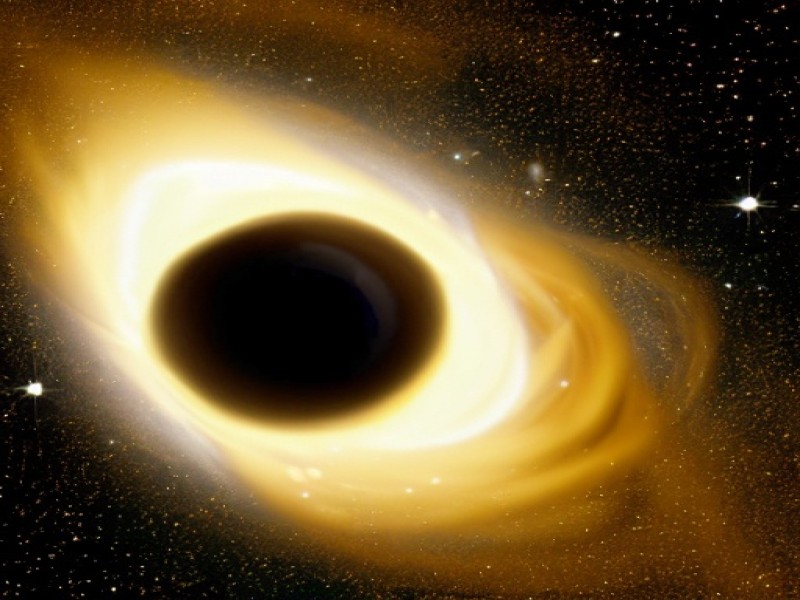
Article image generated by artificial intelligence
However, stars can approach black holes from various angles, so the formed accretion disk is not necessarily aligned with the rotation of the black hole. For some time, it oscillates as if swaying, until it stabilizes or disappears.
Astronomers from the Massachusetts Institute of Technology (MIT) decided to use these oscillations to measure the rotation speed of the black hole, which directly affects the swaying of the disk. It is also necessary to know the mass of the black hole for this.
A suitable object was found at a distance of about a billion light-years. In 2020, several observatories recorded the tidal disruption of a star in a distant galaxy. A bright flare in the X-ray range was named AT2020ocn. Subsequently, bursts of radiation were observed at intervals of 15 days. This was caused by the rotation of the oscillating accretion disk.
The scientists observed it for 200 days. They managed to measure the mass of the black hole, which turned out to be 2.5 million times more massive than the Sun. This information, combined with the characteristics of the disk's rotation, allowed them to estimate the rotation speed of the black hole. It is approximately a quarter of the speed of light.
Individually, this value says little. However, astronomers are encouraged by the possibility of applying this methodology to study a large population of black holes. They hope to gather extensive information about the rotation speeds of various objects to better understand their evolution and growth mechanisms. After all, during the absorption of stars or merging with other black holes, the rotation speed is expected to change.
We and selected third parties use cookies or similar technologies for technical purposes and, with your consent, for other purposes (“basic interactions & functionalities” and “measurement”) as specified in the Cookie policy.
You can freely give, deny, or withdraw your consent at any time.
You can consent to the use of such technologies by using the “Accept” button. By closing this notice, you continue without accepting.
 TGLIST.COM.UA
Comments
No comments
Add Comment