The atmosphere is dominated by nitrogen and carbon dioxide. However, there is a problem with the host star.
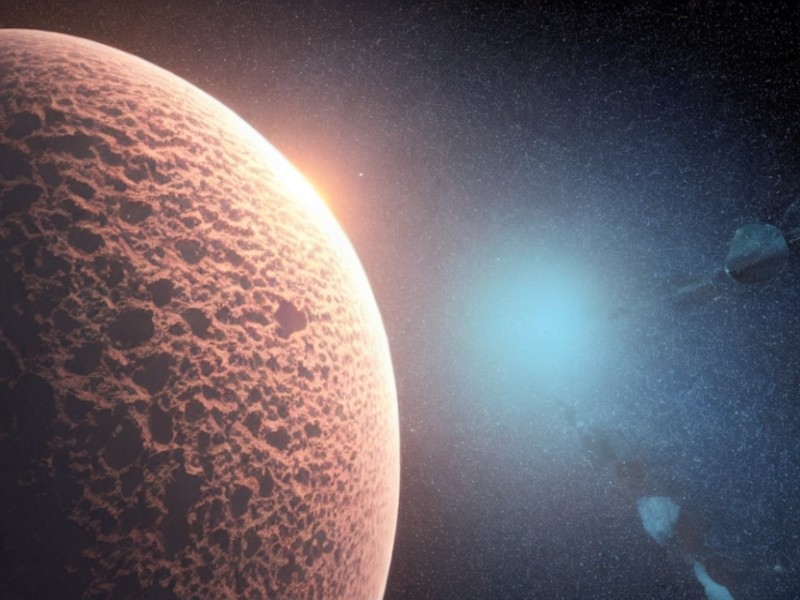
The LHS 1140 system is located about 50 light-years away from us. It previously had two known planets classified as super-Earths. A new study conducted using the "James Webb" space observatory has refined the parameters of one of them. Astronomers concluded that it may have conditions suitable for life.
Article image generated by artificial intelligence
The authors of the study used two transits of the planet LHS 1140b against its star to obtain spectral data of the atmosphere and specify the physical parameters of the object. It turned out that the mass of the exoplanet is 5.6 times that of Earth, and its radius is 1.73 times that of Earth. It is much closer to its star than Earth is to the Sun. However, LHS 1140 belongs to the class of red dwarf stars of type M, making it significantly cooler than our Sun. This suggests that the average temperature near the surface of LHS 1140b hovers around 226 K (about minus 47 degrees Celsius).
Before the "James Webb" review, it was assumed that this super-Earth has a dense gas atmosphere dominated by hydrogen. However, the reassessment of the planet's mass and the evidence from the NIRSpec spectrometer indicate that this hypothesis should be reconsidered. Most likely, the atmosphere contains a significant proportion of nitrogen, water vapor, and carbon dioxide. In this case, for the mass of LHS 1140b to match the observed one, it must consist of ten percent water, indicating a large ocean.
The temperature conditions and the presence of liquid water on the surface of LHS 1140b make this planet an attractive candidate for supporting life as we know it. Another important component is the presence of certain chemical compounds. They may be detected through additional observations.
However, planets in orbit around red dwarfs face additional challenges for habitability. Due to their proximity to the stars, they may be tidally locked, meaning they are always facing one side towards the star. Additionally, red dwarfs are prone to powerful flares that can "sterilize" nearby planets. Therefore, even if one of them is in the habitable zone of an M star, it does not guarantee conditions suitable for life.
We and selected third parties use cookies or similar technologies for technical purposes and, with your consent, for other purposes (“basic interactions & functionalities” and “measurement”) as specified in the Cookie policy.
You can freely give, deny, or withdraw your consent at any time.
You can consent to the use of such technologies by using the “Accept” button. By closing this notice, you continue without accepting.
 TGLIST.COM.UA
Comments
No comments
Add Comment